
LuckyElf reputation and complaints
Is LuckyElf Legit? Reputation, Complaints and Risk Signals
 Available in US
A useful LuckyElf “legit or scam” review cannot be reduced to one badge. LuckyElf’s Terms identify Metlait SRL as the operator and state Tobique Gaming Commission licence No. 0000064. AskGamblers currently lists three Lucky Elf complaints in its complaint-service context, with the two accepted complaints shown as resolved; the visible complaints centre on withdrawals. Australian regulatory record is a separate category: ACMA listed luckyelfcasino.com in a 2022 website-blocking action, and its 2026 report records action involving Metlait on Spinrise and Lucky Vibe, not LuckyElf itself. These signals should be weighed independently. An overseas licence, resolved complaints and a working website do not create Australian regulatory authorisation, while an enforcement record does not prove that every customer experience is the same.
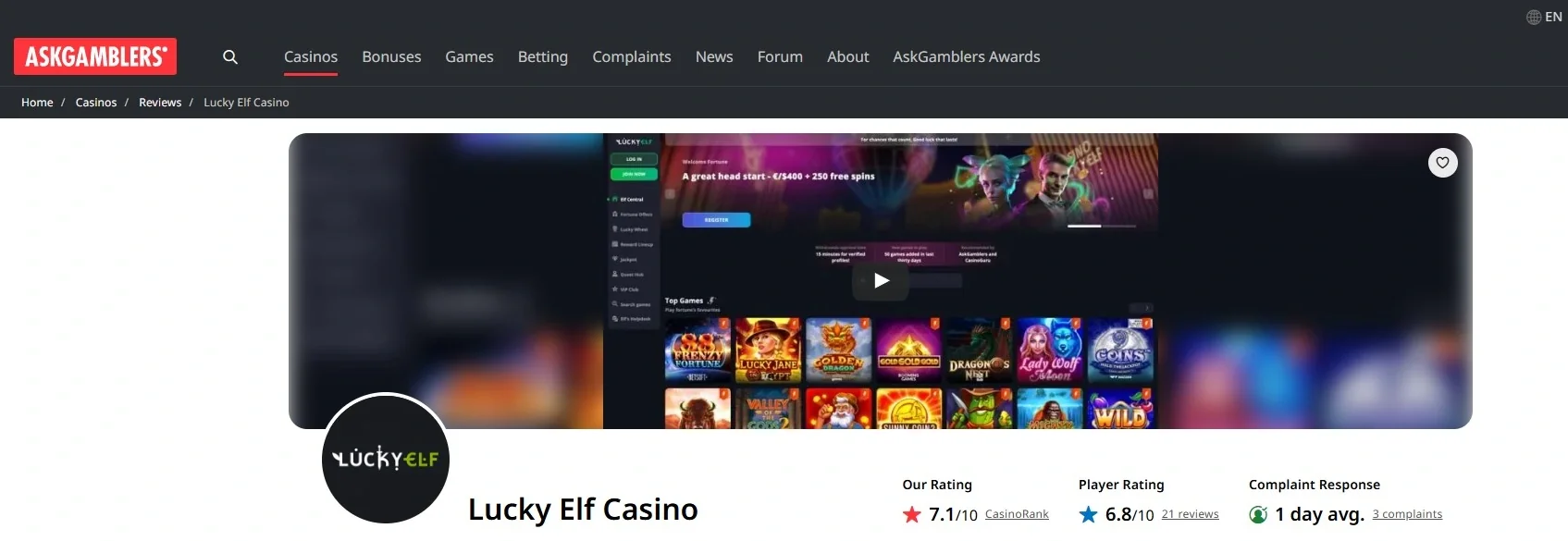
Table of Contents
- Reputation signals at a glance
- Why reputation is not a single yes-or-no label
- Operator identity and published terms are positive transparency signals
- What the current AskGamblers complaints actually show
- Withdrawal and KYC transparency are practical reputation tests
- ACMA’s 2022 LuckyElf action is a direct Australian risk signal
- Metlait’s 2026 ACMA actions are operator context, not LuckyElf-specific warnings
- Game access is not a trust certificate
- Practical reputation factors
- LuckyElf reputation FAQ
- How the reputation signals fit together
- The complaint record is small and concentrated on withdrawals
- Bottom line on LuckyElf’s reputation
Reputation signals at a glance
| Area | Current signal | How much weight to give it |
|---|---|---|
| Operator identity | LuckyElf’s Terms name Metlait SRL and give Costa Rican company registration details. | Useful for identifying who the site says operates the service. |
| Stated licence | LuckyElf’s Terms state Tobique Gaming Commission licence No. 0000064. | Relevant overseas licence information, but not Australian approval. |
| Complaint record | AskGamblers currently describes three complaints, with both accepted complaints resolved. | Useful context, but a small and changing sample rather than proof of universal experience. |
| Australian enforcement | ACMA blocked luckyelfcasino.com in Q4 2022 and later acted against Metlait on other brands in 2026. | Important regulatory risk context that must be attributed by domain, date and brand. |
Why reputation is not a single yes-or-no label
The word “legit” can mean several different things: that the website names an operator, that it publishes terms, that an overseas regulator is named, that complaints are handled, or that the service is authorised in the reader’s own country. Those meanings are not interchangeable. LuckyElf can have a traceable operator and stated licence while still raising a separate Australian regulatory problem.
LuckyElf’s reputation involves several separate signals: operator identity, the stated overseas licence, complaint handling and Australian regulatory history. LuckyElf publishes Metlait SRL and Tobique licence No. 0000064, AskGamblers lists a small complaint record, and ACMA records Australian action involving the LuckyElf domain and, later, Metlait on other brands.
Operator identity and published terms are positive transparency signals
LuckyElf’s Terms and About information carry the same operator and licence details, giving the brand a consistent published corporate identity.
The Terms include eligibility, payments, KYC, withdrawals, complaints and dispute escalation. These provisions make the operator’s stated account and dispute rules visible, but they do not guarantee that a particular dispute will be resolved in one way or turn LuckyElf into an Australian-licensed provider.
LuckyElf’s reputation can be separated into identifiable components: the named operator, stated licence, withdrawal and KYC terms, complaint channel and regulatory history. Each component describes a different part of the customer and governance picture; none of them alone guarantees a particular future payout or dispute outcome.
What the current AskGamblers complaints actually show
AskGamblers currently says players have made three complaints to its Lucky Elf complaint service. It states that the two accepted complaints were resolved successfully. The visible complaint material includes withdrawal disputes, and the current complaint stats show two resolved accepted complaints.
This is neither a clean bill of health nor proof of a scam. The sample is small, it comes from users who chose to file through one external service, and complaint outcomes can change. A resolved complaint can indicate that a specific dispute reached an outcome through the complaint process, but it cannot establish a universal payout time or prove that every future dispute will be resolved. A rejected complaint also should not be treated as proof that the player’s underlying frustration was invented.
Anonymous player reviews can point to themes such as withdrawal friction or bonus confusion, but they do not establish a precise payout speed, fraud rate or support response time for all users.
Withdrawal and KYC transparency are practical reputation tests
Many reputation disputes become difficult because withdrawal timing and verification timing are mixed together. LuckyElf’s Terms say KYC can be required before a withdrawal is processed and that an incomplete KYC process can leave a withdrawal pending. The same Terms publish minimum withdrawal values and frequency caps, while the payment methods page uses a different processing statement. The dedicated withdrawal process guide explains those different processing statements separately instead of promising one universal payout speed.
For identity checks, LuckyElf lists government-issued identification and proof of address as core categories and can request additional information. The verification process section covers the up-to-30-working-day AML wording. Published KYC requirements improve transparency, while actual case handling can still vary.
ACMA’s 2022 LuckyElf action is a direct Australian risk signal
This is direct LuckyElf-domain regulatory history and sits separately from the brand’s stated overseas licence and individual complaint outcomes.
The wording still needs boundaries. The 2022 record does not establish that every current LuckyElf domain is blocked by every ISP today. It also does not describe every individual player interaction. It is a record that the named LuckyElf domain was included in an Australian blocking action at that time.
Metlait’s 2026 ACMA actions are operator context, not LuckyElf-specific warnings
ACMA’s April to June 2026 report names Metlait S.R.L. in formal warnings involving Spinrise and Lucky Vibe. Spinrise is listed for providing prohibited interactive gambling services, and Lucky Vibe is listed for providing prohibited and unlicensed regulated interactive gambling services. The report does not identify those warnings as LuckyElf actions.
That distinction matters. Because LuckyElf’s Terms also name Metlait SRL, the 2026 report is relevant operator-level context when assessing governance and Australian regulatory risk. But calling it a “LuckyElf warning” would overstate the information. The correct statement is that ACMA took 2026 action involving the same operator name on other brands.
Game access is not a trust certificate
A large catalogue or familiar software provider can make a casino feel established, but neither proves local authorisation or reliable dispute handling. LuckyElf’s Terms contain Australia-specific restrictions for some providers, including NetEnt and Amatic. Those restrictions are better treated as product-availability facts rather than an overall assessment of the entire service. The game offer page separates the broad catalogue from provider-level restrictions.
Likewise, an operational website, working cashier or accessible account form should not be used as proof that ACMA authorises the service. Technical availability and regulatory status are different questions.
Practical reputation factors
Operator identity, the stated overseas licence, complaint handling, withdrawal rules and Australian regulatory history describe different parts of LuckyElf’s reputation. Metlait SRL is named as the operator, LuckyElf states Tobique Gaming Commission licence No. 0000064, AskGamblers lists a small complaint record that includes resolved withdrawal complaints, and ACMA has a 2022 LuckyElf domain-blocking record. ACMA also recorded 2026 action involving Metlait on other brands. None of those points should be used alone as a universal description of every player’s experience.
LuckyElf reputation FAQ
Is LuckyElf a scam?
The available information does not support reducing LuckyElf to a simple scam label. LuckyElf’s Terms identify an operator and stated overseas licence, while independent complaints and Australian enforcement records provide separate risk signals that should be weighed directly.
Does LuckyElf have complaints?
Yes. AskGamblers currently describes three Lucky Elf complaints, with the two accepted complaints shown as resolved. The visible complaints are mainly withdrawal-related, and the record can change.
Did ACMA warn LuckyElf in 2026?
ACMA’s April to June 2026 report names Metlait for Spinrise and Lucky Vibe. That is operator-level context rather than a new LuckyElf-specific 2026 warning. LuckyElf itself has a separate 2022 domain-blocking record.
Does a Tobique licence make LuckyElf Australian-licensed?
No. LuckyElf’s Terms state a Tobique Gaming Commission licence. That is separate from Australian licensing and ACMA’s rules for services offered to people in Australia.
How the reputation signals fit together
LuckyElf’s operator identity and stated Tobique licence improve traceability, while the AskGamblers complaint record shows that withdrawal disputes have occurred and that some accepted complaints were resolved. ACMA’s 2022 action adds Australian regulatory history for the LuckyElf domain, and its 2026 action involving Metlait on other brands adds operator-level context. These points describe different kinds of risk and should not be collapsed into a single score or universal customer outcome.
The complaint record is small and concentrated on withdrawals
AskGamblers currently lists three Lucky Elf complaints in its complaint-service record, with the two accepted complaints marked resolved. The visible cases include withdrawal disputes. Some users have therefore brought cashout problems to an external complaint channel, while the small sample does not establish a universal payout pattern for all LuckyElf accounts.
Those complaint outcomes sit alongside LuckyElf’s published withdrawal and KYC rules. Identity checks can hold withdrawals, and the Terms publish a minimum withdrawal and standard frequency caps. ACMA’s separate 2022 LuckyElf blocking action and 2026 Metlait actions on other brands concern Australian regulation rather than the resolution of individual player complaints.
Bottom line on LuckyElf’s reputation
The reputation picture is mixed rather than binary. LuckyElf publishes a consistent operator identity and Tobique licence, which improves traceability. AskGamblers has a small complaint record in which the two accepted complaints are marked resolved, but the complaints themselves show that withdrawals have been a source of friction for some users. For Australians, the more serious context is regulatory: ACMA directly blocked luckyelfcasino.com in 2022 and later took action involving Metlait on other brands in 2026. Operator transparency, complaint handling and Australian regulatory status therefore describe separate parts of the overall risk picture. The LuckyElf Australia review provides the broader product and Australian context. The licence and Australian regulation page covers the full operator, licence and ACMA position.
Written by the editors at Lucky elf Casino.